
Common Questions About Lifts
What are the main type of vehicle lifts?
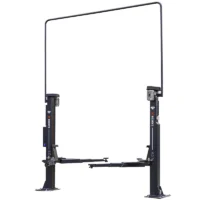
There are a huge array of lifts for all sorts of applications and requirements. Arguably the most common are 2 post and 4 post lifts. Both of these will get a vehicle to a suitable working height to enable the vehicle to be worked on, but a 2 post will give a ‘wheel free’ scenario (for tyre work or general under body work), and 4 post are ‘platform’ and the wheels sit on those platforms exactly as if the vehicle is on the floor, except it is at a working height.
At Giuliano Automotive, we focus on 2 post lifts, because these are the most common for our type of customer base i.e. fast-fit.
How much is the average 2 post lift?
Well, just like cars, you can get incredibly cheap ones, and incredibly expensive ones! Just like cars, the cheaper they are, the lower the quality you can expect and vice versa. Like cars all get you from A to B, all lifts go up and down, but the feel of the ‘ride’, the speed, the noise, and the reliability are all affected by the quality of the lift – just like cars! Cascos, especially the Diamond Line supplied by Giuliano, are undeniably at the higher end of the scale. We don’t apologise for our lifts being more expensive to purchase, because we can absolutely prove that, over the life of the lift, a Cascos is a cheaper buy than some unknown brand sold on online. The question is, do you prefer to buy something that will last, not let you down along the way, virtually maintenance-free, but accept it will cost more upfront. Or do you prefer to pay much less upfront, take a risk, replace it sooner, have some expensive repairs along the way etc etc? A typical Giuliano customer undoubtedly falls into the former category, and so a Cascos lift is the perfect choice for our customer base.
What are the key buying considerations when purchasing a 2 post lift?
There are many, but to name a few...Brand
This is the first ‘insurance policy’, or reassurance, as to what you are likely getting. A good brand is good for a reason. It is so easy nowadays to buy one of the plethora of low cost lifts available from China and put a badge on it. By ensuring you are buying from a known manufacturer, you have a much better chance of long term support, spare parts availability, and likelihood of the supplier staying in business. Do not underestimate the value in a known brand name on a lift.Versatility
People often think that a 2 post lift will cover everything – they don’t. To make a lift that will cover just about every vehicle in the car park also makes for an expensive design. So if a lift is cheap, it will likely be very limited on what you can’ and can’t pick up using the correct pick-up points. A Cascos D4 was designed with this in mind; our first check box was ‘can we make this the most versatile lift on the market’, so that customers can get better value from it. If a manufacturer’s first check box is, as is mostly the case, ‘how can we make this the cheapest lift on the market’, then prepare yourself for some serious limitations on what cars and vans you can mount (correctly!).Warranty
The best way to gauge a company’s faith in their products is by asking what warranty you get, including all the small print! It stands to reason, if you have faith in your product being as good as you claim it to be, then you’ll back it up.Does Country of Origin matter?
Absolutely! Let’s be honest, there is good and bad in anything, and so there are some really good lifts made in the Far East, but there are also some absolute shockers! We don’t want to touch too many nerves, so we will focus on what we can be certain of. That is, we can be certain that Cascos has been manufacturing in Spain since 1965. We can be certain they remain a family business to this day, passionate about what they produce. We can also be certain that the product is built to do a job for a long time first and foremost, and having been in this business a long time, we can be certain that this situation provides us with a lot of comfort when ensuring longevity and reputation.
How thick does the concrete need to be to install a 2 post lift?
This is a great question, because it has many variables depending on the quality of the floor and the type of lift. Typically, most lift authorities agree on approx. 180mm depth, but it is worth considering the grade of concrete, its condition, and whether the lift comes with a structural baseplate (which will spread the load but does mean you lose the benefits of a clear floor), or if the columns are free-standing. The best case scenario is to discuss your own circumstances with the supplier, and maybe even your builder if there is any doubt or concern. Most conscientious lift suppliers will do a site survey first anyway, and it is worth noting that the Cascos D4 is supplied with FloorSolver steel ‘plates’, which provide an additional security for fixing by spreading the load, without absorbing valuable internal floor between the columns.