
Giuliano Automotive UK Tyre Equipment
The facts around accurate wheel balancing, and the limitations of the ‘common cone’
Regardless, whatever make or model you end up with, one common feature is the 3 or 4 cones you will receive for mounting the wheel onto the shaft of the balancer. But did you know that mounting a wheel on a cone is not actually the way OEM fitment facilities balance wheels? This is because mounting a wheel by the centre bore is not actually the most accurate way to balance.

That is a very common misconception, and understandably so. If you buy a product at a great price that says it will do just that, then why would you spend any more Well, let’s use an analogy to explain. Would it be true to say that all cars get you from A to B? Of course it would, but do they all achieve it in the same way? Absolutely not! The vehicles available on the market will get you there in different levels of comfort, with massively varying economies, varying levels of reliability, cost of ownership, and life expectancy.
The same applies to balancers. It is worth noting that the majority of production and development has traditionally been done in Italy; they have always been the masters. But, like lots of products in all walks of life, there is now a massive amount of production made by Chinese producers, and there is nothing wrong with that, and in general the price reflects it. Italian manufacturers tend to patent their technology, and a patent can be renewed after 10 years for another 10 years. So, when a factory attempting to produce low cost alternatives copies something that has been made in Italy, it has to respect those patents. In simple terms, what this means is that you are potentially buying the equivalent of a 20 year old Italian machine. Would you choose to buy an 06 plate Vauxhall Astra today, unless you are particularly looking for a classic?!
But all of this is all just background for the real point we are making, which is that investing in the right equipment and understanding what you are buying is just the start. If you are a busy tyre shop, an alloy wheel specialist or, of particular importance, a main dealer, how you actually mount the wheel is almost as important as that machine itself.
Remount Error
Let’s start with explaining the limitations of the cones you get with the balancer. If you have ever had cause to balance a wheel, remove it, put it back on either straight away or maybe later because a customer has come back saying they still have vibration issues, then you may well have found that you get another reading. You know you balanced the wheel, you know you put the weights on in the right place, and you know that, after the checkspin, you got zero’s, so why would it show further imbalance? Well, this is called ‘remount error’. It has absolutely nothing to do with the reliability of the balancer, but is simply down to the connection between the cone and the centre bore of the rim you have mounted.
Back in the day when all wheels were made of steel, the centre bore was pressed out, which meant that the hole was actually pretty accurate (provided you put the cone on first so it entered through the back of the rim, where the circle is perfectly round – hence the old rule that you should always back-cone, never cone from the front). The result was reliable balancing.
With the advent of cast alloy rims, this completely changed. Alloy rim manufacturers don’t necessarily have a duty to ensure the centre bore is 100% accurate for the benefit of us balancer manufacturers, they just need a hole to mount over the hub of the vehicle. In fact, if you put a cone into the centre of an alloy rim, on some of the cheaper products you can actually see daylight between the rim and the cone in certain areas, and this because the hold may actually be slightly elliptical. The moral of the story with this is that, if you mount that wheel on the cone and balance it, go through the motions of getting to zeros, rotated the rim on the cone 180 degrees, you will get another reading. The tiniest of movement that close to the centre of the rim will amplify into a sizeable measurement in grams when rectifying it several inches out. Of course, the larger the rim, the worse this becomes.

The Solution
The part you can rely on to mount a wheel and know it is perfectly centered, is to mount it by the stud holes, replicating the way it is secured on the vehicle. In this way, using the cone is merely taking the weight of the rim, allowing the wheel to be secured by a stud plate, and the result is perfect balancing that you can confidently ‘hang your hat on’.
SpeedPlates™
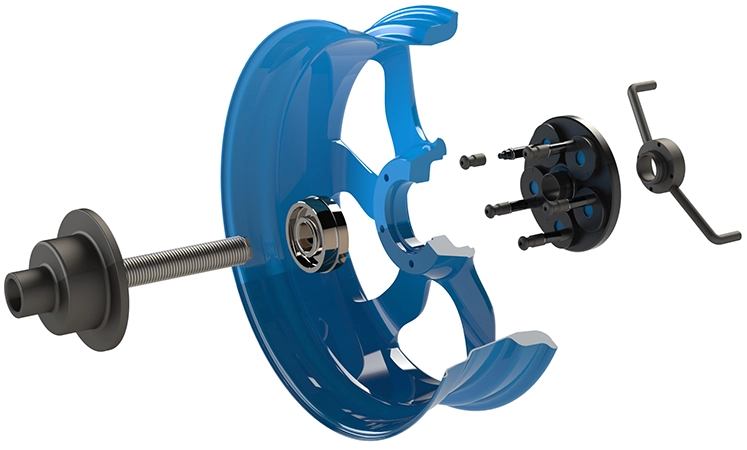
The Oreka SpeedPlates consists of a set of 3 plates and a selection of ‘studs’ to cover 4, 5 and 6 stud rims. Each stud has a conical shape to proved perfect seating into each stud hole. The rim is then secured in the normal way, either by locking handle or, if you have opted for automatic clamping, by pressing the pedal (SpeedPlates can be supplied with an additional adaptor which allows it to work on automatic clamping).
This style of mounting is actually recommended by most vehicle manufacturers and many tyre manufacturers, in some cases being mandatory. This is because, like us as manufacturers, someone at a very technical level has understood the lack of accuracy provided by the common cone.

“But everyone I know uses cones, why would I bother investing in the plates?”
That is a valid question, and the fact is that you don’t need to bother investing in SpeedPlates, but it is like anything, it is a decision on what kind of service you want to provide. Do you want to remove the cost, inconvenience and customer perception from customer ‘comebacks’? Or maybe you would like to present yourself as doing a better job than the ‘average’?
At Giuliano, we have no dog in the fight; all of our balancers come with a set of the highest quality cones, precision engineered and hardened – it doesn’t get any better. But for the same reason we have basic machines with manual data input, right through to high-spec machines with automatic, touchless data input, TFT screen and automatic clamping, we know customers are different.
One this is for sure, there is no point in investing in precision balancing equipment and not making a big deal out of it. Some customers offer precision balancing as a premium service. And let’s face it, if a customer has spent £500 a corner on a car that’s worth £100k, are they going to baulk at the idea of spending another £5 or £10 per wheel to have an ‘OEM’ standard balance, with that ‘new car’ feeling, and getting the money back anyway through longer life of the tyre? In reality, done right, having SpeedPlates can actually add tangible, additional revenue which is clear profit, sends the customer away happy, and sets you apart from the ‘average’! That is the perfect definition of win/win!
Supplying the right wheel balancer is only part of the story at Giuliano, we go much deeper. We take time to ensure the customer buys not only the right model, but the right accessories too.


If you are in the market for a new balancer, or have had any balancing issues with your existing machine regardless of make or model, give us a call and let us tell you more about the latest range of SpeedPlates, which are now even lighter and faster to use than ever. And if you find yourself at a loose end around the workshop, try balancing a wheel to zero, rotating it 180 degrees leaving the cone in the same position, and balance again, and find out for yourself what ‘remount error’ is!
Let’s recap on the benefits of stud-mounting, and the unique qualities of the SpeedPlates system…
Guaranteed Accuracy
Mount the wheel as it technically should be, eliminating any opportunity for customer comebacks.

Profitable
Use the system to enhance profitability by offering ‘Precision Balancing’ as a premium service.

Ingenious Design
A built-in Pressure Ring reduces shaft space usage, so your existing wingnut fits neatly inside the SpeedPlate.
Drop-Safe
Made from a special composite, the plate is designed for the busy workshop where accidents happen. Additionally, a self-releasing mechanism ensures the gear assembly detaches safely if dropped, then clicks back into place without losing balancing accuracy.

Ergonomic SpeedGrip Control
Balanced to rest comfortably on four fingers, the SpeedGrip allows smooth, one-handed adjustment of the bolt pattern (PCD). No need to worry about SpeedPlates taking extra time to balance.

Giuliano Automotive UK supplies premium tyre changers, wheel balancers and wheel aligment equipment designed for long-term performance.